Fast Food
It satisfies hunger, but it does not nourish
Fast food satisfies hunger, but it does not nourish. In the short term, it satisfies; in the long term, it fattens and impoverishes potential.
In football training, fast food also exists.
These are tasks that are quick to prepare, simple to explain, and comfortable to control. Repetitions without context that keep players moving and generate an immediate feeling of work.
The ball circulates, players pass, control, and drive; the organization is clean, and the exercise progresses without interruptions.
Everything seems to work.
But it is worth asking:
Does everything that fills a session really nourish player learning?
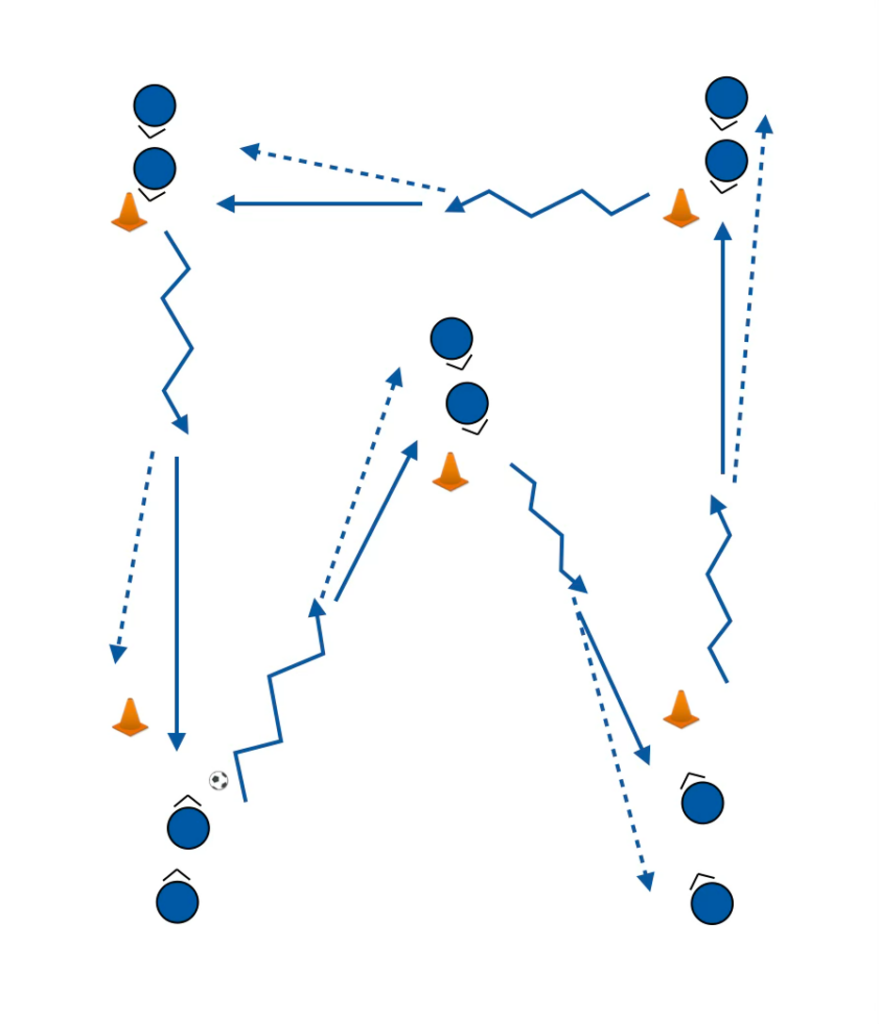
The image on the left represents an usual passing drill. The path is defined, the movements are marked, and the player knows in advance who will pass to them, where they must pass, where they must move, and what action they will perform next.
The player executes, but barely needs to observe, interpret, prioritize, decide, inhibit, or adapt to a changing environment.
The action is already decided before it appears.
There is no relevant information to discover, no advantage to identify, no risk to assess, and no real game problem to solve.
The task may improve the execution of the gesture, but not necessarily the ability to use it when the game demands it.
Like fast food, it produces immediate satisfaction. It generates many repetitions, occupies a large part of training, and produces the impression that the player is learning. However, when these types of tasks become the main basis of the training process, the same thing happens as with a fast food diet; it fills up but does not nourish.
An alternative that nourishes learning
The task located on the right maintains technical content similar to the previous one, such as passing, control, and driving, but introduces them into a context in which the player needs to observe, interpret, and decide.
In this proposal, three players interact through passes in Zone 1, while a red defender conditions progression from Zone 2, without being able to invade it.
When one of the wide players receives (blue 6 or 4), they must observe the position of the defender (red 9) and assess whether they have enough time and space to advance towards the mini-goals.
If they perceive that the defender is far away, they can take advantage of the space and drive the ball.
Driving no longer appears because it is part of a memorized sequence. It appears because the player has interpreted the environment and recognized an opportunity to progress.
During the advance, in Z3, they will encounter a second defender (red 8) and must solve a 1×1 situation, with the possibility of linking up with the teammate located on the opposite side.
Passing, control, and driving remain present, but now they are related to space, time, the position of opponents, collaboration with teammates, risk, and the intention of the action.
Technique ceases to be an isolated repetition and becomes a tool to solve the game.

Learning when to advance and learning when not to advance
The richness of the task is not only that the player learns when to drive. They must also learn when not to do it.
If they perceive that the red defender is too close, they must assess the risk of turnover and inhibit their first intention to progress.
At that moment, they can keep the ball, attract the opponent, fix them, and play backward or link up with the unmarked player to “gift” them time and space.
Here appears one of the capacities that best distinguishes an intelligent player: inhibition.
Inhibiting means slowing down an available response when information from the environment indicates that it is no longer the most appropriate.
In football, many turnovers do not occur due to poor execution of an action, but due to not having inhibited an action that should never have been started.
The player may intend to drive, but must understand if it is really convenient for them to do so. They no longer act because it is their turn, they do not repeat because the sequence demands it, and they do not advance because the coach has so decided. Now they observe, interpret, assess the risk, and choose; sometimes they drive; sometimes they maintain possession, sometimes they play backward, and occasionally, they inhibit the first intention to create a better advantage.
The how, the when, and the why
The passing drill can help repeat the how: how to pass, how to control, how to drive.
But the game demands much more. The player needs to learn:
- When to use each resource;
- Why use it;
- What to do it for;
- What risk do they assume;
- What alternative exists;
- And when they must inhibit the first response.
A player can complete hundreds of passes correctly in a drill and yet not recognize during competition when to pass, drive, fix, maintain possession, or play backward.
Correct execution does not guarantee an appropriate decision.
And a technique that does not respond to game information loses much of its value.
And with young children?
Some coaches justify using passing drills by claiming that they represent a necessary first step when working with young children.
Nothing could be further from the truth.
From the earliest ages, we must begin to build in their brains a decoding system that allows the player to interpret the changing environments of the game.
This does not mean subjecting the child to excessively complex tasks. It means adapting the difficulty of the experiences to their age, their level of maturation, and their capacity for comprehension, without eliminating the essential elements that give meaning to the game.
It is not about simplifying the task until it is emptied of information.
It is about designing accessible situations in which the child can begin to:
- observe what is happening;
- identify relevant information;
- choose between different possibilities;
- inhibit a response when it is not appropriate;
- and execute the selected action.
Observation, decision, inhibition, and execution should not be worked on as separate capacities, nor incorporated only when the player is older.
They must be stimulated systemically from the beginning of the training process.
In the early stages, we should not eliminate the complexity of the game; decisions should be simpler, spaces clearer, opposition less complex, and the number of alternatives smaller. There must always be something to observe, information to interpret, and a response to select.
In this way, we begin to build, from an early age, the basis of the player’s decoding system. A basis that will not slow down subsequent learning.
It accelerates it.
The sooner the child learns to relate what they perceive to what they decide and execute, the more prepared they will be to understand progressively more complex situations.
We must not prepare the player to decide in the future.
We must teach them to decide from the beginning.
It is not about eliminating technique
It is not about eliminating technique, but about returning its true meaning within the game.
Playing well does not consist solely of executing an action correctly. It consists of perceiving what is happening, interpreting the context, and deciding if that action is the most appropriate at that moment.
Sometimes, the best decision will be to advance. Other times, to maintain possession. And at certain moments, to inhibit the first intention to generate a subsequent advantage.
Technique acquires value when it responds to a need of the game.
Therefore, we are not looking for players who only know how to pass, drive, or dribble. We look for players capable of understanding when, why, what for, and when to use each resource.
Before designing a task, perhaps we should not only ask ourselves:
- What technical gesture do I want to work on?
- What will the player have to observe?
- What information must they interpret?
- What decision will they have to make?
- What response must they inhibit?
- What game problem will they have to solve?
The context is the key. Its design will largely depend on the quality of the experiences the player lives and, with them, the configuration of their neural connections.
Let’s not limit brains.
Let’s not limit our players’ potential.
As coaches, we have the responsibility to design contexts that challenge the player to observe, interpret, decide, inhibit, and act.
The future of football depends on the quality of the experiences we offer them every day.
The future of football is in our hands.