Introduction
Today we talk about Di-Soñar.
Di-Soñar is a book about education and methodology in disguise, hidden within the dialogues between parents and their son, in their reflections, and in more than thirty stories filled with metaphors and learning.
Di-Soñar consists of “helping others achieve their dreams while we try to achieve our own.” And that is, ultimately, what we try to do in our daily lives, at work, and in our environment. I am sure that many of you are also an example of this.
It is a simple book.
But sometimes it is precisely the simplest ideas —when you wrap them in emotion— that have the greatest power to provoke change.
I simply wrote the book I would have liked to read.
Writing is a different way of offering something, without knowing who it will reach or what it will awaken in the person who receives it. Perhaps that is the true reason why we write.
With that uncertainty and also with that excitement, at Smartfootball we want to open Di-Soñar from its very first page and share the full Chapter 1 with you.
It is brief —barely a page— but within it lies the root of everything that will come next: a way of understanding education, values, childhood, and dreams.
This is only a first reflection on a small part of the book. In the coming weeks we will share new perspectives, fragments, and reflections that will appear periodically on this blog.
We invite you to read it slowly.
Without hurry.
Back Cover
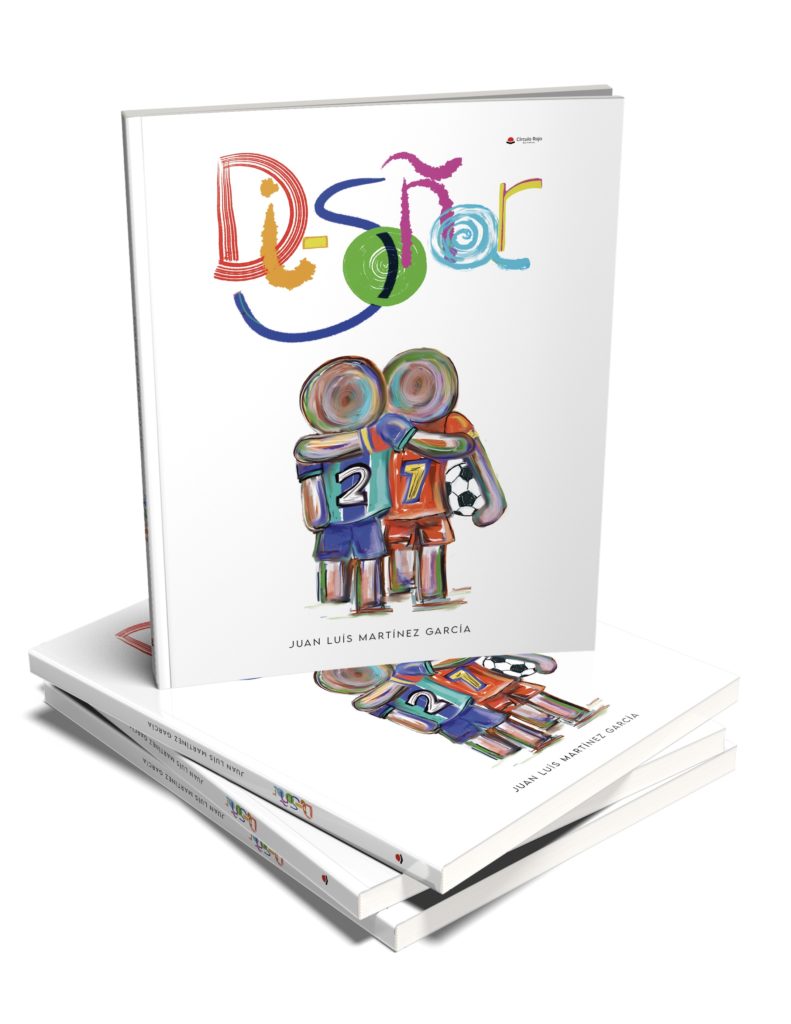
“Children should never stop dreaming, and we, as parents and educators, must help them be happy while they try to achieve their dreams. This is the story of a boy named Álex who, like so many boys and girls around the world, had a dream: to become a footballer. It is a story full of stories, reflections, learning, science, education, values, and optimism, aimed at children, parents, coaches and, of course, grandparents, who are an essential part of our children’s education. It is also a story about football, where all of us will see ourselves reflected in each of the experiences that Álex and his environment will live through on this long yet passionate journey that every boy and girl must travel to one day become not only good footballers, but good people.”
Chapter 1 · The First Place
It was late and, as every day, I returned home after an endless day, tired and with my head full of worries. I urgently needed my daily dose of “family,” to be only a father and forget, if only for a few hours, about work. I knew that behind the door my wife and my son Álex were waiting for me with a smile and an infinite desire to see me, hug me, and tell me things.
Hi Álex, how was everything? How was school? What did you learn today? Did you have a good time? Tell me something that made you laugh. Did you help someone? How was football training?… These were the usual questions to begin our daily reflection and they responded to a pact the three of us had “signed”: “Every day we will dedicate time to talk and listen to each other.” Listening… such a simple word and yet so complex. Listening means more than hearing; it means paying attention and includes looks, empathy, closeness, and silence.
Nowadays, unconsciously, we are settling for hearing our children instead of truly listening to them. The order of priorities shifts and, without realizing it, our relationship with them deteriorates and, consequently, their education weakens. We are physically with them, but our thoughts are somewhere else. A relational mutation between parents and children that is deeply concerning and that we must reverse at all costs.
The Greek philosopher Zeno of Citium said that we were given two ears and only one mouth so that we would listen more and speak less. Let us, therefore, make our children feel attended to. Let us enjoy their purity and innocence while they are still young, because the time we dedicate to talking and actively listening to them is, without a doubt, the greatest gift we can give them and the greatest gift we can give ourselves.
We were never the same again. Living in another country, far from your home, with another language and another culture, allows you to review and rethink the order of the things that truly matter. And family, talking, listening, sharing, and giving each other time would always take first place.
Reflections
The title of the first chapter is full of meaning. In a world that constantly pushes us to climb positions —better job, more recognition, more results— the chapter poses an essential question:
what truly occupies first place in our lives?
That is why this chapter opens the book: because before talking about dreams, football, effort, or goals, it was necessary to remember what truly matters.
You cannot teach a child to pursue their dreams if you have not first given them a safe place from which to dream. Only when a child feels valued and supported can they dare to do so with confidence and perseverance.
“The First Place” is family.
It is listening.
It is presence.
It is shared time.
The chapter begins with an intimate and universal scene: a father returning home exhausted after an endless day. It is not only physical tiredness; it is the mental burden of the contemporary adult.
The phrase “I urgently needed my daily dose of family” works like an emotional scalpel: family is not a complement, but an antidote. The word dose associates family with a healing treatment, something that repairs from within. There is no idealization here, only recognition of fragility. The narrator needs to disconnect from the noise of the world and return to what is essential.
“To be only a father…”
The word “only” is very powerful. It does not mean “less”; it means “fully.” In that expression there is a conscious renunciation of other roles: professional, responsible, concerned. It is not ceasing to be the rest. It is choosing which version of oneself wants to be present in that moment.
Educating requires presence, and presence cannot be divided.
“and to forget, if only for a few hours, about work.”
Here time appears. It does not speak of a definitive disconnection, but of a parenthesis. Work does not disappear. Responsibilities are still there. But for a few hours, the order changes.
The door then becomes a symbolic threshold. On one side, work, responsibility, pressure. On the other, home: a space of love, belonging, and emotional rest.
“I knew that behind the door my wife and my son Álex were waiting for me with a smile.”
The act of receiving him is not merely a narrative device; it is emotional pedagogy in its purest form. Before any dialogue exists, the child speaks with his body: he runs toward him, hugs him, looks at him. And the father understands, without the need for words, that in those movements there beats a message impossible to pronounce yet unmistakable: “we were waiting for you”
The initial dialogue is not trivial: “How was everything? How was school? What did you learn today?”
This sequence forms a ritual, a daily exercise that teaches how to think, to remember, and to give words to experiences. Asking is not inspecting, but accompanying. The father does not interrogate about grades or results; he asks about experiences, emotions, impacts.
That moment condenses the chapter’s first great lesson:
Educating is not only speaking.
Educating is also creating a space where the child can speak and feel happy.
The scene becomes even stronger when the family signs a pact: to dedicate time every day to talk and listen. That “the three of us signed” turns communication into a life commitment. There are no hierarchies: father, mother, and child are equal before the word. Education ceases to be vertical —from parents to children— and becomes circular —among everyone.
In many homes, education is reduced to instruction: “do this,” “don’t say that.” Here, the opposite happens: education is born from listening. The author reminds us that children do not need adult answers; they need adults who allow them to formulate their own questions
The word listening becomes the backbone of the chapter. It is not defined abstractly, but emotionally: listening is attention, gaze, gestures… and also silence. In an age dominated by notifications, haste, and multitasking, the chapter denounces an almost imperceptible yet devastating phenomenon: absent presence.
“We are physically with them, but our thoughts are somewhere else.”
Here appears one of the book’s most powerful metaphors: relational mutation. The parent–child bond transforms into a parallel coexistence where space is shared but not life. Like a player who is on the field, but plays for himself and not for the team.
The chapter does not judge. It points. Parents are not guilty; they are victims of an accelerated world. But the solution exists: to recover the order of priorities.
The quote from Zeno of Citium arrives like a gentle blow: two ears and one mouth to listen more and speak less. Pedagogy is not invented; it is remembered. Stoic philosophy places listening as a cardinal value. The author introduces it to connect eras: education does not belong to a trend or a specific century; it is a permanent human task.
“Enjoying their purity and innocence while they are still young” is not a beautiful phrase; it is a conscious responsibility.
That is why “the time we dedicate to talking and actively listening to them is, without a doubt, the greatest gift we can give them.”
Why?
Because when a child feels listened to, they strengthen their self-esteem, develop emotional security, and build a solid foundation from which to face the world.
But it is also the greatest gift for us.
Because when we truly listen, we stop living on autopilot, we force ourselves to slow down, we recover the present, and we reconnect with what is essential.
Shared time is not measured in quantity, but in presence. A few minutes of genuine attention are worth more than hours of distracted coexistence. And those minutes, accumulated day after day, build memory, bond, and trust.
Childhood does not need great speeches or future promises. It needs adults who are there. Who looks. Who listen.
That is the gift.
A gift that is not wrapped, not bought, and not recovered if lost.
A gift that educates the child… and re-educates the adult.
“We were never the same again”.
Childhood passes. Stages follow one another. What seems ordinary today will be a memory tomorrow.
Living far away, changing environments, altering routines… sometimes life forces us to stop and look with perspective. And when we look from a distance, we understand something that was always there: time does not stop.
Children grow up. The opportunities to listen to them, to receive certain hugs, to share certain confidences… will not be repeated. The passage of time is inexorable. But the way we order our priorities is a choice.
That is why the chapter ends as it began: reminding us what must occupy the center.
Family.
Talking.
Listening.
Sharing.
Giving each other time.
Not only while they are young. Not only when circumstances allow it.
Always.
Because “The First Place” is not a stage.
It is a decision, a way of understanding life.
And of living it before time moves forward… without asking permission.
To Continue Di-Soñando.
Chapter 1 is only the beginning.
The book continues with more than thirty stories that expand this view on childhood, education, and the way we accompany dreams.
If this first chapter has connected with you, if it has awakened a memory, an emotion, or a question, perhaps the rest of the book has something to tell you.
Di-Soñar is available through our website.